Many students begin IELTS Speaking Part Two with a little background introduction to the topic. Mm-hm. If you do that, you’ll probably confuse the examiner. Let’s find out what to do instead. (Upbeat music) Welcome! Hello, it’s Keith from the Keith Speaking Academy and English Speaking Success, where you become, I hope, a more confident speaker of English.
Make a Good, Concise Start
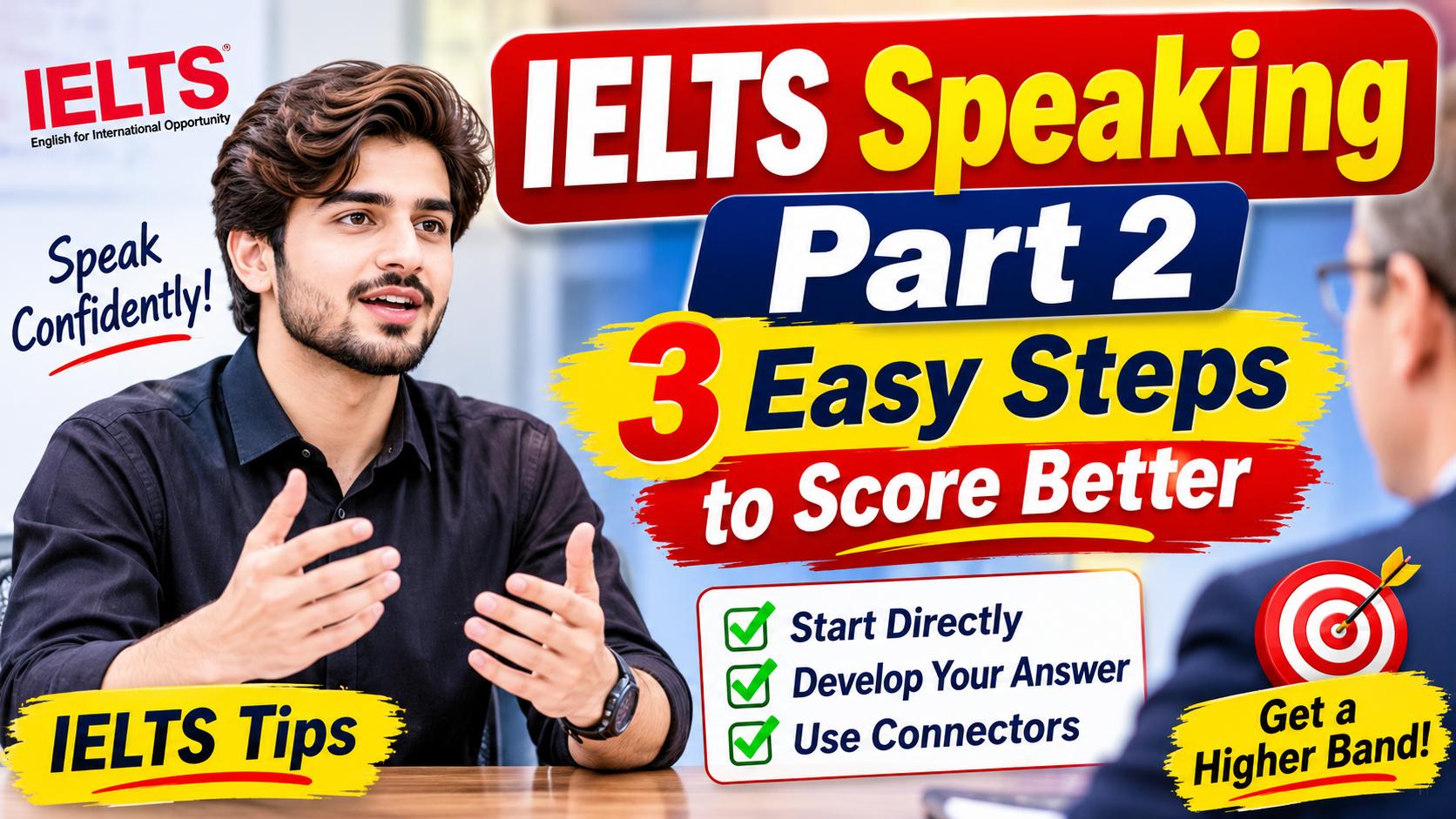
In this video, I want to talk you through three simple steps that will help you give a fantastic answer in IELTS Speaking, and stick around to the end ’cause I’ll also give you a sample model answer illustrating these steps and all the tips. Let’s do it! Step 1. Step number one: make a good, concise start. Succinct just means short and to the Purpose. Don’t go About the houses.
Describe a Tool You Use in Your Home
So for example, this question, okay: “Describe a tool you use in your home.” Don’t start like this: “So, there are many tools in our homes nowadays that help make our lives easier, ranging from electrical appliances like a hairdryer to non-digital tools like a pair of scissors. Pros and cons abound for all of them, but today I want to talk about one tool I often use to help me at work, and that is my computer.”
You Are Confusing the Examiner
Now, apart from being memorized, right, the problem here is that you are confusing the examiner. The examiner may think you’ve misunderstood the question, and they may start to get frustrated, and trust me, you don’t want a frustrated examiner; you want a happy examiner. So the first step to a good Part Two answer is to begin directly.
Acquaint the human being, the Place, the Thing
Acquaint the human being , the place, the thing, or the Action , the event that you are going to talk about. So here I might say, “So yeah, the tool I use in my home that I want to tell you about is my computer.” Got it? Now, there are plenty more phrases you can use to start your Part Two answer. In this video, go and check it out later. Right now, let’s get into step number two.
Step Number Two: Develop Your Answer
Step 2. So, step number two: develop your answer. How do we do this? Let me give you some tips on how to do it. Tip number one: prepare three things to discuss. Now, you can use the three bullet points on the card, but you don’t have to. You can make up your own. IELTS do it. It’s super easy.
Use the Common Question Words
All you do is use the Ordinary question words: the While Which , how, who, where, why. Talk about any of those that are appropriate, okay? So remember, the bullet points are just a guide, but have three things you can talk about. Let’s take our question from earlier: “Describe a tool you use in your home. You should say...” You can say what it is, what it does, why it’s Practical and Definition how you feel about it.
Much Better Would Be to Describe It
Now, the mistake that many students make is to just give one phrase or sentence to answer it. So to say what it is, they might say, “It was a pair of scissors.” Too short. Much better would be to describe it. Think of adjectives. Something like this: “It’s a pair of scissors that I bought several months ago from a local hardware shop. They’re quite big and very sharp, and they have plastic handles that make them easy to use.” So you’re developing.
Say What It Does
Second bullet point: say what it does. Don’t do this: “Well, it can cut paper.” They can cut paper. Much better would be to develop this, maybe give some examples and explain something like: “Well, scissors are normally used for cutting paper, but I guess they can also cut bags, plastic, even wires. I actually bought them because I’m a teacher, so I need to cut up lots of pieces of paper and card to prepare for my classes.” Give some examples.
Say Why It Is Useful
Bullet point number three was say why it is useful. Don’t do this: “Well, it’s useful for cutting paper and opening boxes because they’re sharp.” Snickers. It’s not bad, but it could be better if you developed it like this: “Well, they’re super useful because they save me time, right? It would be pretty hard to cut paper with a knife, and maybe dangerous too. So scissors, yeah, are much safer in that sense.” Got it?
The Satan Is in the Particulars
Tip number two to help you Evolve your answer is to be Particular In English, we say the Satan is in the Particulars . TheParticul ars are really important, right? So contains Precise examples, give personal feelings, short, Story are short stories about your life, the things you tell your friends and family when you get home from work or school.
Make Your Answer More Engaging
So you make your response, you make your answer more engaging, and you’re gonna demonstrate more vocabulary with the more detail you go into, okay? So in the question about the tool, bullet point number three, it says, “Why say why it is useful.” You could say something like this: “Well, yeah, they are useful for cutting paper and opening boxes because they are sharp, the ones I have. Yes, they’re easy to use as they have a big handle. Also, anybody in the house can use them, although we do have to be careful with our baby daughter and make sure they’re kept out of her reach so she doesn’t cut herself.”
Tip Number Three Is to Use Connectors
Can you see? You are starting to tell a little story, reveal things about your life, the kind of thing you would tell a friend, revealing more details. Remember, the devil is in the details. Tip number three to help you develop your answer is to use connectors. Connectors are these words that connect your sentences and your ideas. They help everything flow and make sense, also making it easy for the examiner to follow you.
That Will Make a Happy Examiner
Remember, that will make a happy examiner. You don’t want a frustrated examiner. Now, some of the most common connectors are actually signposts. They signpost; they show what you are going to say: firstly, on the one hand, on top of that, and finally. And this keeps your answer or your speech coherent, keeping the examiner happy, right?
Don’t Ever Use Written Connectors
Now, some teachers do say, “Don’t ever use written connectors. Don’t say ‘however’; say ‘but.’ Don’t say ‘in conclusion’; say ‘to sum up.’ Don’t say ‘for instance’; say ‘for example,’ ‘such as.'” I don’t totally agree with that. I think it’s fine to use all of those, right? In most speaking Condition it’s very hard to say “don’t ever” because it depends on the situation and what you are talking about.
We Use Very Simple Connectors
It is true, generally speaking, when we speak, we use very simple connectors: firstly, and, but, so, then, after that, and that’s fine. That’s how we speak, I think. With formal connectors, there are only two I would avoid in speaking ’cause they are very formal, and they are “furthermore” and “nevertheless.” They’re even difficult to say. So rather than “furthermore,” just say “what’s more,” and rather than “nevertheless,” you could say “but anyway,” right?
Another Mistake That Students Make
By the way, another mistake that students make sometimes, if they’re new to IELTS, is they look at the bullet, the cue card, the bullet points, and as they’re giving the answer, they talk or they say the actual bullet point, right? So in the example above, “Describe a tool. You should say what it is.” Don’t do this: “I’m going to describe a pair of scissors. First, what it is. It’s a pair of scissors.” Duh, no, right?
Think About Connectors
Think about connectors. Make it more coherent. Something like: “The tool I’m gonna describe is a pair of scissors. First of all, let me tell you a bit more about what it is. De-de-de-de-de-de.” Right, something like that. For the second bullet point, what it does: “Talking about what it does, de-de-de-de.” Third bullet point, don’t just say it, why it’s useful. You could say, “Well, when it comes to why it’s useful, I would say da-da-da-da-da.” So can you see these connectors are making your speech more coherent, easy to follow? Happy examiner! Let’s move on.
Give a Brief Conclusion
Step 3. Now, step number three: give a brief conclusion. So this is not an essential step, okay? This is not IELTS Writing, where you must have the conclusion. But if you can control your time and you know you are coming to the end of your time, just one simple sentence to wrap it up, to sum it up, can help communication, and just, it feels good. But it’s not essential, and actually, it really could be something as simple as this: “Yeah, so that’s it. That’s the tool that I regularly use in my home.” That’s it, okay? Great.
A Complete Model Answer
Let’s move on and have a look at a complete model answer using these tips. Cue card model answers. “So, the tool I’d like to tell you about is a pair of scissors. It’s a very special pair of scissors that I bought a few weeks ago in a local hardware shop. They’re quite big, larger than the normal size, with an extra-larger ergonomic handle made out of plastic, which makes them really comfortable for using. Yeah, they weren’t cheap either, actually.
Talking About What They Do
Talking about what they do, well, clearly, scissors are used for cutting material like paper, plastic, even wires. As for me, I use them for cutting card and paper. The reason is that I’m a teacher, right, so I spend a lot of time cutting up flashcards and sticking things together, so scissors, yeah, they come in really handy, actually. In fact, I’d go as far as to say they are an essential for me.
The Reason They Are Useful
When it comes to the reason they are useful, well, as I just mentioned, I mean, I use them for work, but they are very useful because they save me time, and also the fact that they are comfortable means that I can use them for a long period of time without any aches in my hand. Also, anybody in the house can use them, although we do have to be careful with our baby daughter and make sure that, you know, that they are kept out of reach from her so she doesn’t cut herself. Yeah, yeah, so that’s it. That’s the tool I regularly use in my home.”
Three Steps to Give an Awesome Part Two Answer
Did you see how I’m using the steps and the tips to develop my answer? Did you like that? If you did, could you subscribe to the channel? Give me a like. It helps with the channel. Let’s move on. Summary. So there you have three steps to give an awesome Part Two answer, whatever the topic, right?
This Is Not a Science
Step number one: make a good, concise start. Step number two: develop your answer. Step number three, if possible: give a brief conclusion. Do remember, this is not a science. Occasionally you can also just speak out and go with the flow without this Building . It will probably depend on the question that you get, your life experience, and how confident you are.
If You Are Less Confident, Follow the Building
If you are less confident, follow the Building If you are more confident, go with the flow. If you wanna learn more about giving great Part Two answers, check out my online course, “IELTS Speaking: Crack IELTS Speaking Part Two.” Link down below. And if you’re not interested in a course and you just want to study on your own, great, independent study, go and find some cue cards and start practicing some of these steps and tips to help you give great answers.
It’s Time for Lunch
Right now, I’m gonna go with the flow because I’m hungry and it’s time for lunch. So, I will see you. Thanks for watching, and I’ll see you in the next video after lunch. Take care, my friend. Bye-bye! (Upbeat music)
Every heading is made only from words and phrases that already appear in its paragraph, and the paragraph text is unchanged.
Your title prompt came through cut off after “1. I want you to convert this title a Refined non-AI-generated title…” and no title was Contained . Please send the title and any Residual points (like length or keywords), and I’ll work on it.