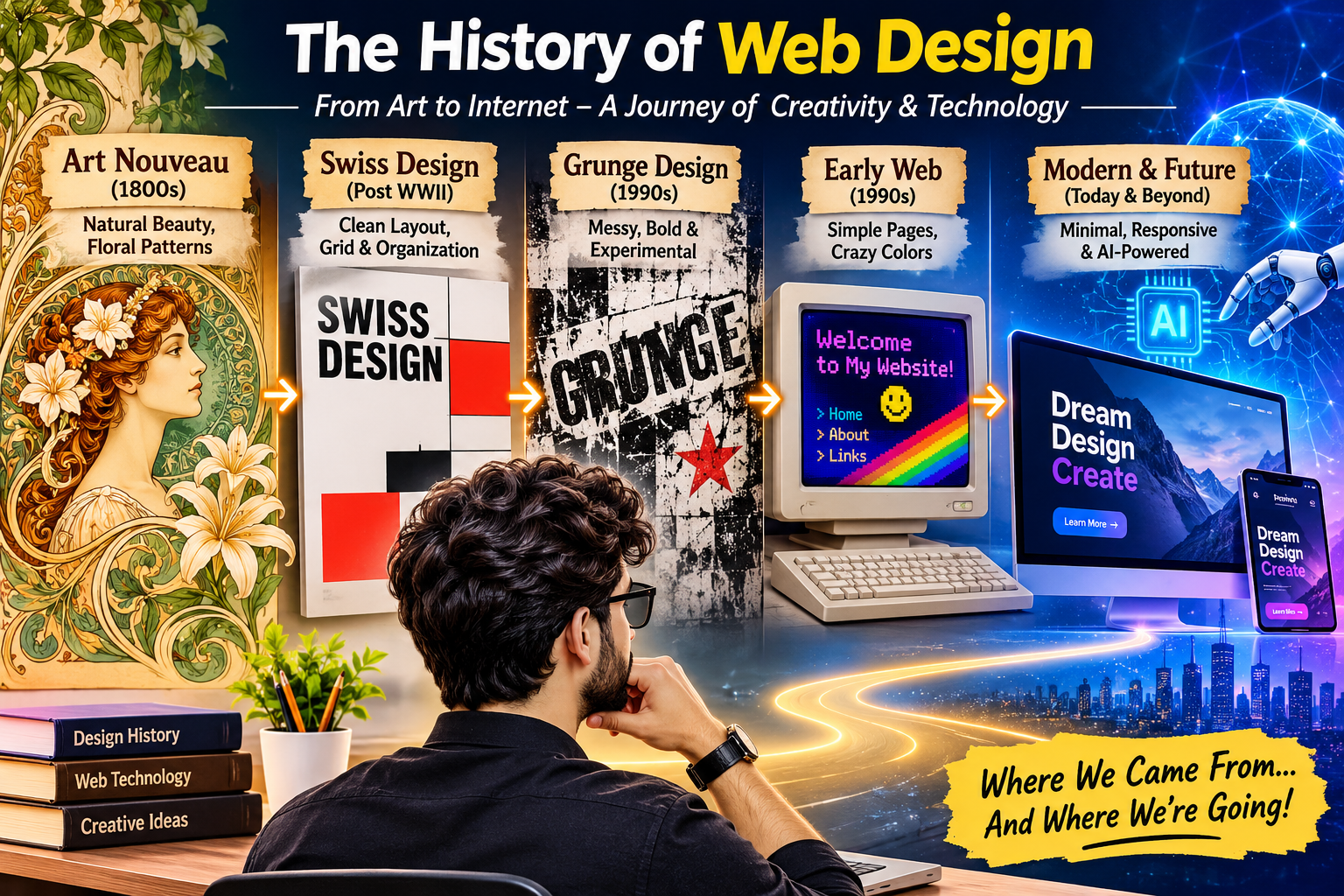
On today’s episode, we’re gonna cover the history of web design and how he got to where we are today and where we’re going from here. Stay tuned, everybody! What’s up? My name is Ron, and welcome back to the free web design course. Today I want to talk about history. I know that’s not maybe what you’re thinking that you need in order to become a web designer. Why do I need to learn history?
Where We Came From and What Happened Before Us
But I think it’s very important to understand how we got to where we are today, because we’re always operating within kind of a context, right? There’s, there’s a context to everything that we do. We don’t actually invent anything, and we have to know where we came from and what happened before us in order to understand why we’re doing what we’re doing today and how to think about moving forward.
Social Context Plus the Technology of the Day
Now, I do think that in web design, and in design in general, in art in general, I think creation always has kind of a social context plus the technology of the day, and when they are combined together, that’s why we’re seeing what we’re seeing today in the world. So before I go into web design, I wanted you to do a really quick review of kind of design, design history, and again, it’s very, very brief and not exhaustive, but because I want to show you that the same principles of social context and technology are what’s making what we’re seeing visually happen.
Art Nouveau
So let’s dive into it. I want to get started at the eighteen hundred, nineteenth century, kind of Art Nouveau, which is basically an art movement that started in French. Art Nouveau actually says new art, and basically this is the first time where graphic design and design was, was used commercially on a large scale for the first time, and it was kind of a reaction to the art that was very popular before, which was very, it was called academic and very rigid, and so the people of the Art Nouveau were trying to break through that using all of these kind of natural and floral patterns.
Natural and Floral Patterns
So as you can see this, and you can see this if you’ve ever been to Paris, you can see this all around, very decorate, a very swirly kind of patterns for what they were using. Now, I want to show you how this is very, very non-minimalistic. This is very actually maximalist thing, and they wanted to use decoration, they wanted to make things pretty and beautiful.
Swiss Design or the International Style
However, a few years later, in the actually post-World War Two, there came a new, actually, a way to design that was called the Swiss Design or the International Style, and that actually, again, was a reaction to what was happening. So after the world went mad during World War Two, people actually felt like they needed order and to really understand what is what, and so the, the graphic design turned into creating a very systematic, very clean, very organized design to make sure that the information is, you know, being passed as clearly as possible, and that ended up with creating this kind of a layouts of very, very rigid grid.
Cleanliness and Grid and Organization
You might say that it’s minimalistic, you might say that it’s very clean, but this is where this whole visual, visual aesthetic of cleanliness and grid and organization came to happen, started out using this period. Now, few years later, in the 90s, actually, a designer named David Carson actually, in a way, we reacted against this very, you know, organized and very clean design by creating what we now call kind of a grunge design by overlaying text one on top of another.
A Surfer or a Teacher
David Carson was actually somebody who never kind of went to design school. I think it was a surfer or a teacher, and he just started out creating surfing magazine, and he tried to be a little bit more extreme and innovative with his design, but he created these kind of layouts where text was one on top of another and not really readable, because he wanted to demonstrate his idea that sometimes readability is not the most important thing.
The Messiness of Your Design
Sometimes you can communicate with the messiness of your design. You can also communicate kind of a vibe and an idea, and that’s basically what he, you can say, he was reacting against. Now, the reason that I showed you this is showing you how what happens in society and how design always kind of reacts to what happened previously, and also kind of the technological abilities that allow you to create what’s happening today.
Where We First Got into the Web
Now, in the world of web design, actually, the 90s or 80s, 90s words where we first got into the web, the web became popular and people started creating for the web. Now, in the night, early 90s, our creation abilities for the web was really, really simple. So basically, there was HTML, which is basically the code, the structure for the web, and basically there was folders. People who got into folders, they were able to read some text or look at some images, but they, that was basically it.
Crazy Colors and Background Colors
Now, as people started to try to be creative about this, using kind of background colors, using different types of, different types of sizes for their fonts or caller, they started to become more, more creative, and then I think in the early 90s a lot of people were really trying to explore this medium for creativity, as in using crazy colors and background colors and, and gifts and whatnot. They were just trying to be as creative as they can with this new technological medium that was, you know, that was invented for them.
Shiny or Glossy Effects Over Buttons
However, you can see that they’ve actually forgot a lot of the history of design when it came to, you know, readability, using grids, making, making the content actually accessible, and so as time moved along, so here you can see the Apple website in the early 2000s. They were just trying to get back to what they actually learned earlier in graphic design. Let’s make things cleaner, let’s use kind of a structured grid, but what you can see here that during the early 2000s, it was very popular on the web to try to emulate these effects of real life, so kind of like shiny or glossy effects over buttons, and because the, the, the technical abilities of structure and layout on the web were pretty limited in terms of, you know, using grids, and then CSS, which is basically the framework of how we design elements on the web, people were still using kind of like tables, so it’s very kind of a rigid design, and you can see this on this ICQ page.
My Favorite Messenger
Basically, ICQ, if you don’t remember it, used to be my favorite messenger back in the early 2000s, still very kind of rigid design and, and sometimes not very clear, everything is mashed together, still screens were very small at the time, and so that’s why, why these designs came to be. Later on, in the 2000s, flesh became very popular, so flesh was basically in kind of an animation software that allowed publishing for the web, so a lot of the website had these crazy, now that it was a lot of the ability to create more elaborate interactions and interactive ideas, so website became pretty crazy.
The Decay of Flash
However, what happened was when, when Apple came out with the iPhone in 2007, Steve Jobs kind of made, made a decision that he doesn’t want to support this format flat on the iPhone, and that eventually led kind of to the decay of flash as a web technology, just because Apple was so popular and dominant that their decision not to support this made a lot of people choose not to use this technology, and actually it died. I think it was in 2017 that Adobe decided to discontinue flash, and fad technologies basically dead these days.
Flat UI in Flat Design
Now, you can see that in 2009, actually, Zune came out with their first, first time that they were trying this kind of a flat, flat UI in flat design system, because, again, this was a reaction to everybody’s trying to create this cool, fancy effect on the web and in user interface, and the, the kind of reaction against it was, let’s try and clear, clear up and minimalize again, kind of like when, you know, the, the Swiss Design kind of try to bring back cleanliness and organization into graphic design.
Big Players Such as Apple and Google and Microsoft
This also happened in the web design during the, mm, intense kind of way, and by that time a lot of, a lot of, you know, big players such as Apple and Google and Microsoft decided to create some kind of a basic, basic guidelines for design in terms of how you should design, how you should create interfaces, and having these kind of standards all around that designers all around the world started to pay attention to, along with new wet web technologies such as CSS3 and a lot of animation type of things allowed the web to, and also responsive web design.
Mobile Devices Have Become So Popular
So at that point, the 2010 already, mobile devices have become so, you know, so popular that everybody has them, and every website now, at this point, basically needs to be also responsive, which means needs to learn how to adapt for big screen and smaller screens, so it looks great on mobile as well. And so basically right now, let me jump kind of into kind of a newer web design. So now we have technologies such as, you know, WebGL, which allows us to create kind of really interactive, and, and like, you can see here there’s like 3D animation and particle animation that’s being rendered full, you know, live on the, on the browser, so really crazy things can happen.
A More Minimalistic Approach
We have a lot of kind of video backgrounds. These things right now can be loaded pretty easily to create a really more dynamic website, but on the other hand, again, people are trying to go for a little bit of maybe a more minimalistic approach. We now have these kind of like cool CSS, CSS and other animation types, but we’re trying to kind of go minimalize that the use of them, so that, you know, people will have an easier time to consume the information that they want to, while we’re exploring, you know, different technologies to make things cool and innovative.
Accessibility Is Becoming a Very Big Thing
So that was kind of a quick run through to where we are today. I think looking forward, accessibility is becoming a very big thing and a major concern. How is your website accessible enough for people with disability of all ages can consume your website? Are there easy, are they easy to consume? Do they look great on mobiles?
Always Take a Look at History
So these are a lot of the questions that we ask ourselves today when we’re looking at web design and when we’re thinking about designing new website that we hope will, you know, be valid or still be good within a few years. Let me know what you thought in the comment. I do recommend, in general, if you want to be a good designer, always take a look at history. I do recommend taking, in general, there’s great kind of art history classes and web design history classes and, and articles and books to broaden your horizon about what happened before.
Let Me Know in the Comment
This will also inspire you when you’re creating something new, have a little bit of context about what happened before. Let me know in the comment which was your favorite period in web design or in design in general, and we’ll see you on the next episode of this free course. If you’re still not subscribed, make sure you’re subscribed, make sure the bell button is turned on so that you’ll be notified when we come up with lots of new videos in this free intro course. See you on the next, you.
Every heading is built only from words and Expression that Previously Emerge in its own General , and the General text is Unaltered . I only Profited the first letters of the heading words.
Your Communication cut off at the title Immediate , so I didn’t see a title to work on. If you Glue it, I’ll help with that coming after in order, . If you want to keep it Rigidly human-written, I can also Construct one from Expression in the Copy , such as “The History of Web Design.”