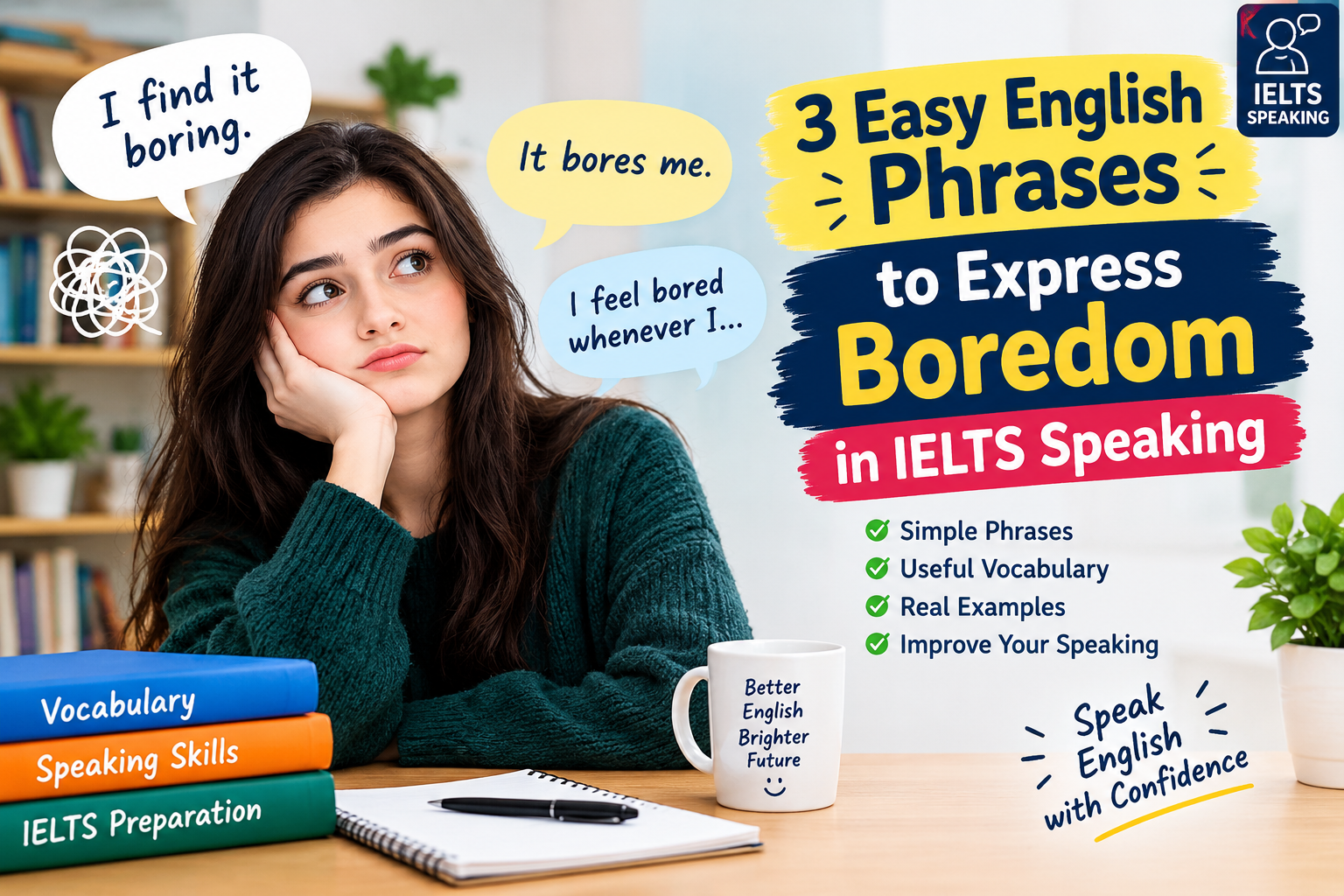
Let’s have a look at some useful phrases for you, and these are three short phrases we can use to talk about this. Here we go. Imagine somebody asks you, “What do you think of history? What do you think of art? What do you Believe of Government?” like in the IELTS Speaking Test. Here are three simple expression: “I find it Dull .” “I find it ba ba ba.” “I find it, it is history or art or politics, I find it boring.”
Or second one, “It bores me.”
Or second one, “It bores me.” It is the thing, history, art, politics, “it bores me.” Or “I feel bored whenever I study history. I feel Uninterested Anytime I study or listen to Lawmaker ” Okay, so three simple Expression you can use: “I find it Dull ,” “It bores me,” “I feel bored Anytime da da da da da da da.” And just let me Clarify each one Concisely
The adjective is the verb plus I-N-G
The first one, “I find it boring.” Notice here, the adjective is the verb plus I-N-G, because this is the impact it has. It is boring, the impact on you. Gosh, you know, right? It’s boring. Politics is boring. English is not boring. Football is boring, not boring.
You can use it in different ways
And of course, you can use it in different ways, right? You can say, “I find it interesting,” “I find it fascinating,” but it’s the I-N-G: “I find it ba ba ba,” or “I find politics boring.” There you go, there’s my example. What is your example? “I find politics boring.” Tell me an example. An example for you, right? Something you find boring or interesting or fascinating.
The first step to organizing your answers
Jane, it’s great to see you. “I love the, the, the, what’s the word? Not yeah, the irony of your comment.” “I was blown away by all these idioms.” That is so clever, you’re a very smart lady, Jane. “Thank you very much.” Mamoon, that’s great. Sajjad, well, this is the first step, right? The first step to Arrange your answers is to start with a Blunt answer.
Direct answer and then explain why
What do you think of art? What do you think of Government? Well, “I find it boring because da da da da da,” and then you explain why. Okay, so direct answer and then Clarify why. Let’s see some of your examples, right? Carol, that’s great, I mean, that, that’s building up. “I’ve always found it super boring.” “I find English therapeutic.” How interesting!
You’re taking it to the next level, my friend
“I find your answer interesting.” “I find history boring.” Nice, yes. “I find it interesting to learn a new language.” Absolutely brilliant. “I find it interesting to do something that’s really good.” You’re taking it to the next level, my friend. “I feel annoyed listening to politics.” Oh, I’m gonna come back to that one in a moment.
So remember the I-N-G
“I find it so, Abraham, I find it fascinating.” So remember the I-N-G. Let me just help you there, right? “I find it fascinating.” So it’s always the I-N-G here: “I find it ba ba ba-ing.” Brilliant. “I find football boring.” “I find literature fascinating.” “I find chemistry fascinating.” Brilliant, all of these are really good, nice direct answers.
The second one, “It bores me.”
Carlos, I’m gonna share that ’cause that’s a lovely comment. “I find English interesting ’cause your class is amazing.” Aw, so kind, so kind. August, I do agree, I do agree, yes. So that’s the first one: “I find it boring.” The second one, “It bores me.” And here we’re just using the verb, right? Something bores me. It’s just the, it’s the verb, as simple as that.
That S is really important
“It bores me.” “Cricket bores me.” “Interests, fascinates.” Notice the pronunciation, that S is really important, right? This is what a lot of people forget. Hello? What was that? So listen Cautiously and repeat it: “bores me,” “it interests me,” “it captivate me.” I know you don’t speak like that, especially in the test, but to remember the S, right, when you’re practicing on your own, Magnify it: captivate me.”
Politics is the noun, right?
Really exaggerate, and then you’ll remember when you speak normally, right? So you can say, “It ba ba ba me,” for example. “Politics bores me.” Politics is the noun, right? But also notice a lot of nouns are like “listening to politics.” This is the verb in the gerund, “listening.” This is a noun.
A noun phrase, we call it
So your noun can be one word, or it can be a phrase, a noun phrase, we call it. “Listening to politics bores me.” Okay, give me an example for yourself using this. Something bores me or something interests me. Try and use this. Alberto, you’re right, yes. “I find it ba-ba-ba verb-ing,” exactly, yes. Let’s have a look.
“Making the laundry bores me.”
Something, right? Gunther, yes. “It bores me making the laundry.” Yes, “It bores me making the laundry,” or “Making the laundry,” right? “Making the laundry bores me.” So you could do it the other way around: “Making the laundry bores me,” but actually, “It bores me making the laundry” in spoken English, that’s still good, right?
Something bores him, yeah
“It bores me doing literature review.” Yep, yep. “Driving the car is boring.” Okay, that’s another different kind of example. “It bores me to hear too much noises in the classroom,” too much noise, excuse me, “too much noise in the classroom.” You’re right, yes. Can you say “it bores him”? Yeah, “it bores him.” Something bores him, yeah.
“Education English captivate me.”
Generally speaking, I would put the, generally speaking, okay, I would put the noun phrase first, so I would put something and then “bores me.” Like Sadia, Sadia Khandaker has done, “Driving interests me.” That, I think, is, is right, right? That’s great. “Learning English captivate, me.” Th-that’s it: noun, verb. “Learning English fascinates me,” exactly.
“It bores me to make the cake.”
Oh, thank you, Tway. It’s “making the laundry.” Well, yeah, it depends on the, yes, you’re right. Normally we say “doing the laundry,” yes. Thank you very much. “It bores me to make the cake.” Yeah, it’s, it’s a difficult one, this, because “it bores me to do something.” “It bores me to make the cake.”
There is no explanation
It’s okay, right? It’s okay, but it’s better to put, put the noun first: “Making cakes bores me,” for example, or “Baking cakes bores me.” Oh, Summer, that’s Fascinating . Third singular is so hard for beginners, yeah. You know, I think it’s, it’s, it’s, it’s difficult to explain because it’s impossible to explain. There is no explanation, it, it just is, I think.
Really exaggerate the S
The key thing is to get them practicing the sound, so that idea of exaggerating. If you’ve got students who are even adults, or if they’re adolescents, teenagers, children, get them to play, play with the sound: “bores me,” “fascinates me.” Really exaggerate the S, and it starts to stick in their head.
“Football bores me to death.”
Carol, “Politics just bores me to tears.” Very nice, very nice. “Cooking bores me.” Brilliant example, but I totally disagree, because “cooking fascinates me.” Okay, good. I’m gonna explain the E-D right now. That’s the next one. “Football bores me to death.” Yeah, “Football bores me a little bit.” That’s Fascinating
“Listening to music encourages me.”
Kuso, “Listening to the same song on loop bores me.” Natalia, “Eating interests me.” “Eating interests me a lot.” “Travelling fascinates me.” “Listening to music me.” That’s interesting, that is very, very interesting. Let me help you just a little bit. So remember, “listening to,” “listening to music encourages me.”
“He bored me, so we split up.”
Good, Nur Alashi, keep going. I want to encourage you as well. “He bored me, so we split up.” Yes, you can say that: “He bored me.” Absolutely. “He bored me, so we, we split up,” just with the past of “split” is “split,” it’s, it’s irregular, yes. So that’s number two, with the verb. Number three was with the E-D.
The feeling you have, not the impact
Okay, “I feel bored whenever I listen to politicians.” So here the adjective, “bored,” is the verb plus the E-D. The meaning is, is the feeling you have, the feeling you have, not the impact, right? You can say, “The teacher is boring.” That’s the impact. But if I feel bored, that’s my feeling. I am bored, it’s the feeling I have.
“I feel excited whenever I have a live lesson.”
“I feel bored whenever I listen to politicians.” “I feel interested whenever I ba ba ba.” “I feel ba ba ba whenever I ba ba ba.” So my example is, “I feel excited whenever I have a live lesson.” That’s my example, ’cause I’m Keith, of course. I’m a teacher. What about your examples?
Exaggerate, listen and repeat
“I feel something E-D,” bored, interested, fascinated, “whenever da da da.” Give me your example in the chat, and just notice this pronunciation again. Exaggerate, listen and repeat: “I feel bored.” “I feel interested.” “Interested.” “I feel fascinated.” Okay, and if you’re teaching children, the other thing to do is, when they say this, use the emotion you’re talking about, right?
You’ll be super teacher
So you get the children to say, “Ugh, I feel bored.” “I feel, ugh, tired.” “I feel interested.” “I feel fascinated.” And you connect the sound and the emotion and the language. Boom! You’ll be super teacher if you’re a teacher. If you’re a student, just do this in front of the mirror, it’s a lot of fun.
“I sometimes feel drained when dealing with clients.”
Pali says, “I feel bored whenever I read newspapers.” Alberto, let me help you a little bit, you’re very, very close. “I feel interested in their music the first time I listen to their new song.” Song, yeah. Ibrahim, “I sometimes feel drained when dealing with clients.” That is really good, very, very nice.
Some brilliant examples
“I feel zoned out whenever someone explains the complex rules of a sport I do not play.” Wow, more than good, well done. Kazi Emon says, “I feel exhausted whenever I get stuck in traffic jams.” Me too. Gunther, “I feel surprised when meeting an old schoolmate.” Nice, good. “I feel interested whenever I study the natural science, especially chemistry.” Nice, this is really good, some brilliant examples.
“I feel bored stiff whenever I have to iron.”
“I feel fascinated by her new look.” “I feel thrilled when I meet friends.” These are brilliant, really good. Hats off. Elvira, good to see you here. “I feel interested in buying English books whenever I walk past the bookshop.” Also very, very, very good. “I feel bored stiff whenever I have to iron.” I like that, “bored stiff,” right? Very, very bored.
I love your examples
Nice idiom, this is an idiomatic lesson. Wow! And this is a, a final one: “I feel interested whenever I visit a new country.” Brilliant, I like it very, very much. I love your examples, thank you so much for all of those. So you’ve got three nice, simple phrases you can use: “I find it boring,” “It bores me,” “I feel bored whenever.”
If you’re doing IELTS
And if you’re doing IELTS, answering this question, right, just say, “I find it ba ba ba ba ba because ba ba ba ba ba,” and just say why, and then maybe give an example. “I find it fascinating when I visit a new country because I can meet interesting people. For example, last week I was in Wales and I met a really interesting person in a shop. We had a great conversation.” Voila, boom, done! Okay, so if you’re doing IELTS, these can really help you with that.
Every heading is made only from words and expression already in its own Passage and the Passage areIntact
For the title prompt, your message cut off before the actual title (“I am giving you a title. 1. I want you to convert this title a humanized…”) and I don’t see a title in it. Could you paste the title, and the rest of the instructions if there were more points after “1.”?