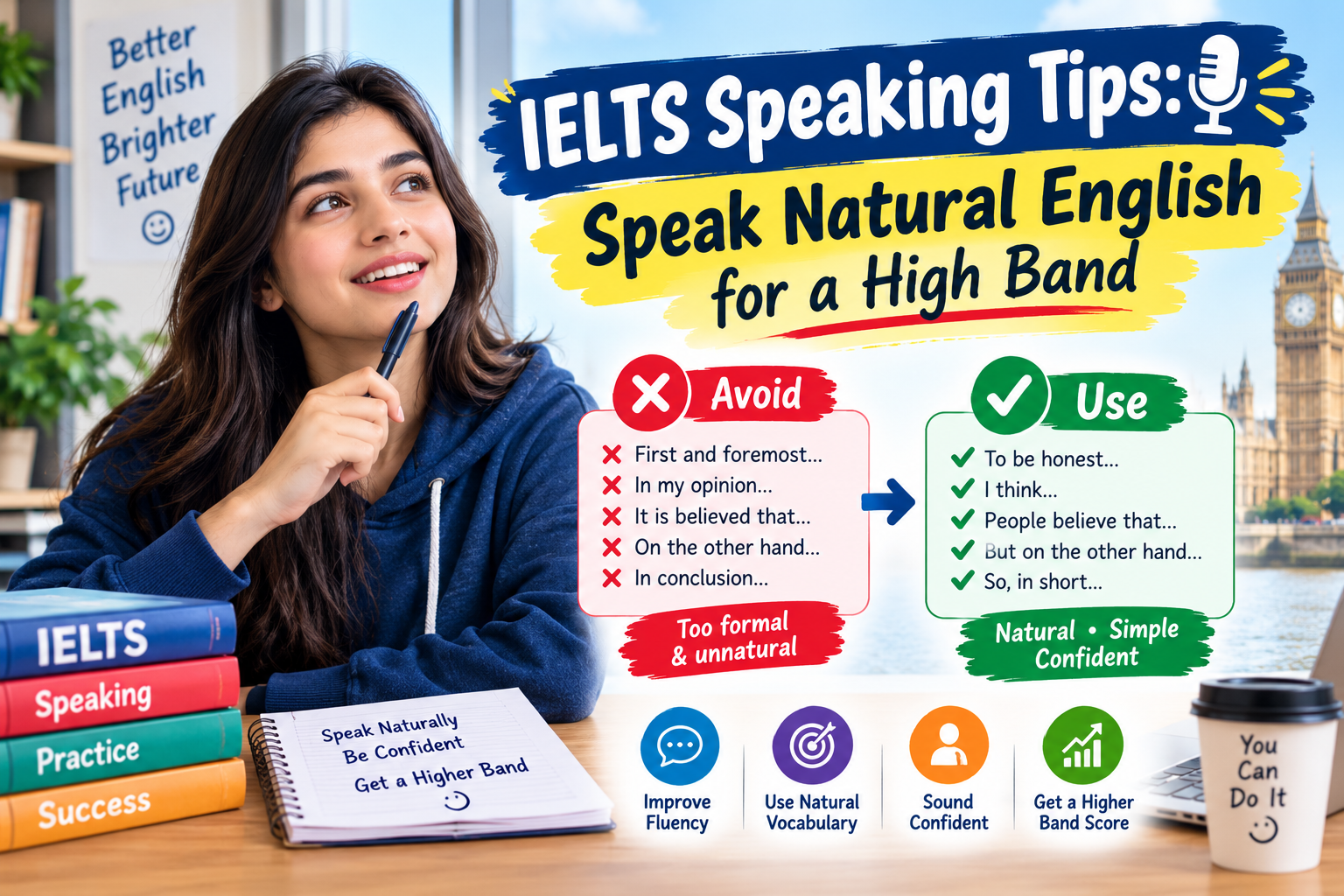
What is the one large blunder, that most students who are new to Show make? Let’s Discover out. Welcome! Hey, come here, listen. Have you seen those videos on YouTube that say, “Don’t say ‘think’, say ‘I am of the opinion that'”, or those videos that say, “Well, basic English: firstly. Advanced English: first and foremost”? Well, let me tell you, they are absolute rubbish, nonsense, and they are the problem, because they are causing a lot of students to think, “In IELTS speaking I must speak advanced English, this complicated language, all the time.”
Natural Conversational English
And often it’s not just advanced English, it’s formal academic English, which is better for writing, good for IELTS writing, but not for IELTS speaking. The truth is, in Show speaking you need to speak natural colloquial,English, and that is a mixture of simple English and complicated language, but not forma lscholarly English. So in this video I want to give you 5 examples of more formal academic English for writing, and not to say that, but to show you what to say, the corresponding in spoken organic, English.
Instance 1
Okay? And this way you can Shun Acquiring a lower score by using the wrong kind of English in your IELTS speaking. Let’s do it! Okay, number 1. Example 1. Here’s an example of some nice formal academic English: “First and foremost, children in schools should be taught about financial literacy.” Now, that’s correct and you could say that, but it’s not very natural.
First Is the General at the Start
How would you say that more inherently in English? Right, more inherently I think would be: “To begin with, we should teach children about finance when they are at school.” There are two things happening here. First is the connector at the start. “First and foremost” is much more written academic English. More naturally speaking, you’d say “to begin with”, “firstly”, “first of all”.
The Use of the Passive Rather Than the Active
Okay, so that’s one thing, the connector. Other examples, right, of kind of academic English are “furthermore”; spoken English more likely to say “and also” or “on top of that”. Another one: “nevertheless”; more likely to speak to say “but that said” or “however”. Okay, so connectors is the first. The second is the use of the passive rather than the active.
A Little Bit More Natural When Speaking
So the passive form, if you like, is more common in written English. Of course you can use it when speaking, but as a tendency we tend to use it more in writing than speaking. Speaking, we tend to use the active more. So instead of “children should be taught”, the active would be “we should teach children”, and that’s just a little bit more natural when speaking.
Instance 2
Okay, let’s move on to our second example.Instance 2. Okay, here’s number 2, a nice scholarly verdict “Many separate are of the opinion that social media has a harmful effect on Community That would be lovely in an IELTS writing essay. Now, how would you say that in natural spoken English? Right, I would say, more Inherently, “A lot of people think social media is bad for society.”
The Issue Is Mostly terminology
Okay? The issue with the first part is mainly terminology , right? “Many individuals”, we don’t really say that, right? “A lot of people”. Then vocabulary about opinion, right? “They are of the opinion that”, lovely writing. Speaking, “I think”, right? We do say “I think” in English, actually. zero wrong with it.
Keep It Simple, but Keep Your Fluency
Other examples might be, kind of more formal academic writing, “from my perspective”. I would say “personally, I think”. And then finally you’ve got vocabulary around “social media has a detrimental effect on society”. I think that’s fine for speaking, actually, but if you don’t have that level of advanced vocabulary, keep it simple. It’s “social media is bad for society”. Keep it simple, but keep your Eloquence
Instance 3
Okay, great. Let’s move on to number 3. Example 3. Right, number 3. Here’s an interesting example: “The restaurant which opened near my home last year has become extremely popular.” “Extremely popular.” Now, that sounds okay, but to me it sounds a little bit like a student has written the answer, memorised it, and then spoken it, right? And it’s kind of okay, but I think it could be a lot more natural.
We Have to Think on Our Feet
And the important thing here is the relative clause here, using “which”: “The restaurant which opened near my home has become…” It’s a planned sentence. Often, not always, in spoken English we don’t plan long sentences. We have to think on our feet, think in the moment, think quickly, so we tend, not always, we tend to use short phrases, right?
It Doesn’t Have to Be That Simple
“There’s a restaurant near me, it opened last year, and now it’s really popular”, chum chum chum. That’s more how we’re gonna speak that sentence in a more natural way, right? Now, some of you may say, “But Keith, that’s too simple, and if I give simple answers I get a low score.” No, not at all. It does not ‘t have to be that simple.
You Get a Points over the Entire Test
It could be “There’s a restaurant near me, it opened last year, and it’s become really popular”: present simple, simple past, present perfect. Absolutely great. There’s an important point: the examiner does not give you a score for each answer, “that answer’s a band 9, that answer’s a band 6”. No, you get a score across the whole test.
Candidates Often Sound Robotic
So your natural spoken English sometimes is going to be simple, sometimes more complex. Got it? Good. Let’s move on. Break. Right, short break. Do you know, many examiners, they say that candidates often sound robotic, too robotic. And you sound robotic when your answers are too polished, and that happens when you write out your answer and then speak. It’s just not natural.
Throw in a Natural Filler
So when the examiner says, “Well, do you like reading?” and you say, “I derive immense satisfaction from devouring literature”, and the examiner’s like, “What? Uh-oh. Oh no.” I mean, yeah, “I really like Perusal ” is Superior, or throw in an idiom: “I’m really into reading.” Throw in a normal filler: “I’m really into reading, actually.” That is norma lverbal English.
Sound Human and You’ll Get a elevated, Score in IELTS Speaking
That’s what you need. So don’t write out your answers, speak out your answers. Sound human and you’ll get a higher score in IELTS speaking. Let’s get back to our video. Example 4. Right, number 4. Nice formal academic, great for writing, this one: “Furthermore, technological advancements have significantly altered the way people communicate.” Okay, good in writing.
The Biggest Issue Here Is the First Word
How would you say that more naturally? Okay, for me the biggest issue here is the first word, “furthermore”. It’s very formal. It’s unusual to say that. I would just say “also”. And then “technological advancements”, you mean “technology”, right? Because technology is always advancing. So I would actually say something like “Also, technology has really changed how people communicate.” Okay?
Make It More Natural
The second bit, “has significantly altered the way people communicate”, is also good. If you’ve got that level, then that’s fine, but if you want to keep it simple, keep it simple. But definitely the first word needs changing. Make it more natural: “Also, innovation has really changed how people communicate.” Let’s move on to number 5.
Example 5
Example 5. Okay, number 5, this one: “In ending, it is evident that workout plays a crucial role in Preserving good health.” Great to finish your IELTS writing essay,completely, But speaking, how would you say that more naturally? I might say, “So yeah, I think exercise is really important for staying healthy.” What’s changed?
In Conclusion, That’s Too Formal
First of all, again, the connector at the start. “In conclusion”, that’s too formal, I think. When we’re speaking, we often just say “so yeah”, “so yeah”, or “all in all”, or maybe “so overall”. Okay? Much more natural. Then we’ve got these chunks of written language: “it is evident that”, hello, “I think”, right? Maybe “it seems to me”, but “I think”.
Be Human. Natural Spoken English.
“Plays a crucial role”, “it’s really important”. Take the written chunk, make it into a spoken chunk, right? “Maintaining good health”, “stay healthy”. It’s more natural. Okay? It’s not that the writing is wrong, it’s just a bit more formal, robotic, and the speaking is more natural. And remember, the key to success in your IELTS speaking is natural. Be human. Natural spoken English.
Tips
Let me give you a couple of tips to help you practice this. Tips. Number 1: don’t write out your answers, speak out your answers. When you get a question, just speak out your answer, even if it’s different every time. That’s good. Number 2 is listen to more and more natural spoken English. Just listen to lots of English.
Things That Are Not Scripted
Try and get things that are not scripted, so listening to maybe interviews, chat shows, what we call soap operas in the UK. It’s like a drama show, like EastEnders, Coronation Street. They are based on everyday life of everyday people. Panel shows. There are some podcasts I listen to, you have a panel of experts and they’re speaking.
A Mix of Simple and Complex
There’s the Gardening Tips, yeah, sad, I know, Kitchen Cabinet, about food, but you’ve got a panel and it’s just live interaction. That kind of listening is going to be really, really good for you. And just remember this: it’s not about using simple English all the time, it’s a mix of simple and complex, but just sound human. Okay?
There Is a PDF Here You Can Download
There is a PDF here you can download. This is to review, practice. Have a look, think about all of this, and start practising your answers, speaking out loud, and it’s going to help you get a higher score in your IELTS speaking. Let me leave you with a final example and ask you to make it sound more natural: “I watch cinematic productions frequently.” How would you make that sound more natural? Let me know in the comments.
Thank You So Much for Watching!
Can’t wait to see you all soon. Thank you so much for watching! Final word: if you want to access more private videos in my membership, come and join the YouTube channel. Press the join button. You get access to more videos each month: private insights, IELTS model answers, lots of stuff to help you do well in your spoken English and your IELTS speaking test.
Once Again, Thanks for Watching
Once again, thanks for watching. So yeah, bye. It is, it, it is, it, it is, it.
Every heading is made only from words and phrases that already Emerge in your text, and the paragraphs are Altered .
Your title prompt came through cut off, and no title was Comprised Send me the title and I’ll work on it.