Permission you understand me when I speak English? What about listening to native speakers in a natural conversation? Sometimes it can be a bit like graphics swooshing, right? Where’s the conversation going? What are they talking about? Let alone you controlling the conversation. But today I’m going to show you how to master the art of English conversation so you can understand and be comprehended, Let’s do it! happy, hopeful, music.
Hello, It’s Keith from the Keith Speaking Academy
Welcome! Hello, it’s Keith from the Keith Speaking Academy and here to help you become a more confident speaker of English. Now, you may find that when you listen to me or other videos or podcasts, that you can understand quite a lot, but maybe when you go into a real conversation with various or several native speakers or proficient speakers, you can’t follow the conversation. It’s hard to know what they’re talking about, and sometimes when you say something, people go, “What are you talking about? We’re finished talking about that,” ’cause you can’t keep up.
The Cues or the Signposts
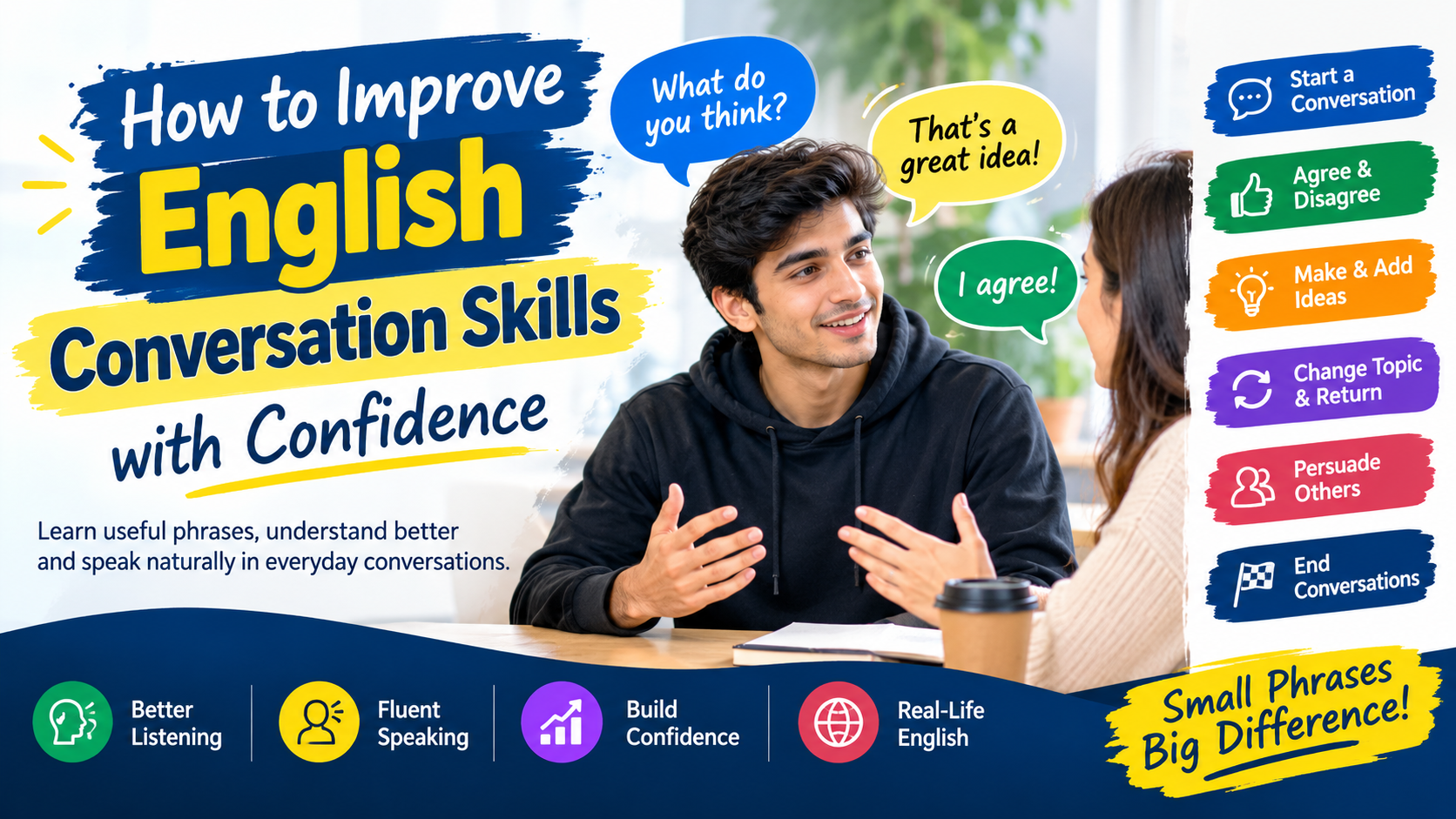
The reason is because you may not be following the cues or the signposts that native speakers use to control the conversation and to take the conversation in different directions. So today I’m gonna give you some key phrases, these signposts that we use to control conversations, so that you can understand and be understood in a native speaker conversation. I’m gonna show you how to start a conversation, agree, disagree, make an idea, add ideas, change topic, return to a topic, persuade people, end conversations, all of that in a very, very simple way with very spoken signposts. Graphics swoosh.
Starting a Conversation
Starting a conversation. Okay, let’s begin with starting a conversation. Right now, of course, when you meet up with friends, there’s gonna be greetings, a bit of small talk: “Hello,” “Hi,” “Ya,” “How’s things?” “What’s happening?” “What’s up?” maybe with American English. But then you want to take a particular topic, introduce a topic, and start getting ideas about it, right?
Introduce the Topic First
So you may think the most common one is to say, “What do you think about da da da da?” But actually, that can be problematic because maybe they’re not aware of that topic. So it’s much better to introduce the topic first and then ask their opinion, right? Typically, we would say, “Have you heard about ba ba ba? What do you think about that?” “Have you heard about the new social media ban in Australia, right? What do you think about that?” Or even better, “What’s your take? What’s your take? What do you think about it?” Right?
What’s Your Take?
An alternative is “Do you know that da da da da? What’s your take?” “Do you know that social media ban in Australia, right? What’s your take?” And there you’re signposting to start a conversation. Next, agreeing and disagreeing. Graphics swoosh. So now you’ve kicked off the conversation, people are gonna give their ideas, their opinions, and you now can agree.
Fair Point
Maybe now, of course, you can say, “I agree.” That’s fine, but here are some other things you’ll probably hear when people first kind of agree softly or accept an idea. They may say, “Fair point.” “Fair point,” if they agree with an idea. A very common word in English is “indeed.” “Indeed” just means “Yes, I agree.” “Indeed,” after an opinion.
That’s What I’m Talking About
Agreeing a bit more strongly, you could hear or say, “That’s so true.” “That’s so true.” Or even more strongly, “That’s what I’m talking about.” When somebody has identified an idea you agree totally with, “That’s what I’m talking about.” Let’s move on. Now, of course, you may not agree. You may disagree, and you could say, “I disagree,” right, of course.
The Thing Is
But often if you’re hesitating ’cause you don’t quite agree, you’ll hear “The thing is, da da da da,” and then you give your opinion or give the reason you disagree. But you just say, “The thing is.” One of the most common ones, actually, is “Yes, but.” And this is a similar thing. Of course, you may disagree, and you know, often in Britain at least, we try and disagree politely.
That’s All Well and Good, But
Here are three things you may hear or you can say: “Interesting.” “Interesting” meaning “Yes, but you disagree.” “That’s all well and good, but,” right? “That’s a lovely idea, but here’s the problem.” “That’s all well and good, but,” or “Actually,” and then give the counter-argument, right? So you’re kind of saying, “The truth is this, you’re wrong. Actually, da da da da da.” Okay, let’s move on.
Making a Suggestion
Making a suggestion. Graphics swoosh. Okay, next, suggestions, ideas, and interrupting. Okay, now first of all, making a suggestion. Here, imagine the scenario where you’re maybe talking about a possible activity or a plan that you want to do as friends. Probably one of the most common things to say here is “How about this?” and then you make your proposal or your suggestion.
How About This?
“How about this?” Or “I think we should da da da da.” “I think we should go to the cinema this…” You can also use if you’re giving your opinion or idea about another group of people, you know, “I think they should,” “I think he should.” Simple ways of making suggestions. Now, adding ideas. People are talking, they’re giving their suggestions or they’re giving their opinion, and you want to add an idea.
Yes, and What’s More
A really nice one, and one you’ll hear a lot, is “Yes, and what’s more, ba ba ba ba.” “Yes, and what’s more, we should go to the cinema on Saturday,” for example. Interrupting. Graphics swoosh. Next, interrupting. This depends very much on different circumstances. So first of all, let’s take a formal situation, right? Interrupting in a meeting.
Can I Just Say
One of the most common ways is just to say, “Can I just say da da da da?” So you just pause, well, because you’ve given the cue and everybody, hopefully, goes quiet and then listens. “Can I just say…” pause, people stop talking, and then you say what you want to say. “Can I just say, I think we should do this.” That’s in a meeting.
Forgive Me, But
You sometimes hear in interviews with people and with journalists, this happens quite a bit, especially British journalists, they might say, “Forgive me, but da da da da.” And here they’re gonna interrupt because the other person’s talking a lot. The journalist will want to interrupt and say, “Actually, no, I don’t fully agree. Forgive me, but…” Of course, they’re not asking forgiveness, it’s just a way to interrupt.
Down the Pub
If you’re around a table with friends and you’re discussing, or down the pub, interrupting, you just need to say something to tell them you’re interrupting. In some cultures, laughs, the Spanish one and I think maybe Italian are a bit like this, you just talk over people and everybody talks at the same time. In Britain, we tend to say something that can interrupt so people will listen, right?
Do You Know What?
And generally, we would just say, “Do you know what?” and then you’d say your thing. So that’s just a way of interrupting, right? “Do you know what? I think we should da da da da da.” Okay, that’s it. Let’s move on. Changing topic. Graphics swoosh. Right, let’s talk about changing topic and kind of returning to a topic.
Anyway
Okay, so altering topic, the one word you just need to say in English is “Anyway,” and everybody understands it’s time to change topic. “Anyway.” If you want to change topic briefly and kind of do a responsibility , you can say, “By the way, da da da.” So maybe you’re talking about social media and then suddenly you say to someone, “By the way, remind me to go and do da da da,” right? And then you come back to the conversation.
Speaking About
If you want to change topic and talk about a related topic, then you would say, “Speaking about da da da,” and then say your next thing. “Speaking about the social media ban, have you perceiving a sound, there’s a new social media app? Yeah? What do you think about it?” You see that, changing slightly onto a related topic and starting a new related conversation.
As I Was Saying
Now then, if you wanna return to the original topic or your original idea, you can just say, “As I was saying,” and then go back to what you were saying, right? “As I was saying, I think the social media ban was a really good idea.” Okay, nice. Let’s move on. Persuading. Graphics swoosh. Okay, next, let’s look at persuading people, very important, right?
Well, Look at It This Way
First of all, persuading somebody to try and agree with your idea, right, or your opinion. You could say, “Well, look at it this way,” and then you kind of rephrase your idea. But when you hear that they’re trying to persuade you, “Well, look at it this way.” If you’re trying to persuade somebody to take an action, like “I think you should apply for that job,” you could say, “You might as well.”
You’ve Got Nothing to Lose
“You might as well apply for that job.” Or “You’ve got nothing to lose. Go on, apply for the job. You’ve got nothing to lose. Why not give it a go?” Okay, simple ways of trying to persuade people to take action. Graphics swoosh. Showing surprise. Now, I’m gonna add something here, which is quite useful in conversations, is when you are surprised by something.
We Echo the Question
Now, of course, the most common thing is just to say, “Really?” “Really?” like that, right? But often in English, we have this thing where we echo the question. So if somebody says, “I’m getting married,” then you would say, “You’re getting married?” You repeat the question to them, right? “Yes, I’m getting married.” “You’re getting married?” Or you could just say, “You’re getting what?”
You’re Going to Have a What?
If you are really surprised, you put “what” or “how” or “why” at the end. Somebody says, “I’m going to have a baby.” “You’re going to have a baby?” Or if you’re really surprised, “You’re going to have a what?” and the stress is on that “what.” And of course, you could add then things like “No way!” again adding or emphasizing your surprise. “You’re gonna have a baby? No way!”
Ending a Conversation
Right, let’s bring this video to a close. Graphics swoosh. Ending a conversation. Okay, let’s talk about ending the discussion Right now, this depends on the context. If you are in a meeting, you may hear or use “Let’s wind this up.” “Let’s wind this up.” “Let’s finish,” or just “Let’s wind up.”
Right
Okay, one of the most common ones you’ll hear, especially with a group of friends, is “Right.” Especially for English people, whenever an English person is about to stand up and do a different activity, they have to say “Right,” and then they do the new activity. So ending the conversation, you just say “Right.”
At the End of the Day
If somebody’s ending a conversation, if you hear the following, they go, “At the end of the day.” That means what they’re going to say is the most important thing, and for them, the conversation is finished. “At the end of the day, that ban in Australia, it’s never gonna work.” And what I’m really saying is, that’s the end of the conversation for me. Okay, “At the end of the day, da da da da da.”
So There You Have It
So there you have it, a whole bunch of signposts and cues, most importantly, that you can pick up and understand so you know where the conversation is going. As your level improves, you can start using these to also control the conversation as you’re speaking and participating in conversations. I hope this helps you on your trip to master the art of English conversation and help build your confidence as an English speaker.
Your Next Step
Your next step: download the PDF summary. You can get these phrases and more so you can review and maybe do a bit of practice. It’s a great reference to have as well. If you’d like to find out more about my work, go and check out my online courses at keithspeakingacademy.com, and I would love to see you there on the inside.
Thanks Very Much for Watching
In the meantime, thanks very much for watching. It’s been a pleasure being with you and sharing these ideas. I look forward to seeing you soon in the next video or in one of my courses. All the best now. Take care. Bye-bye. sunny positive, music.
Every a direction, is built only from words previously, in the text, and the section are unaltered,
Your title prompt came through cut off, and no title was included. Send me the title and therelaxation of that prompt, and I’ll work on it.