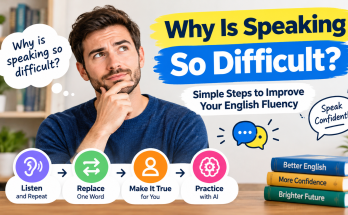
Learning English Can Be Really Simple
Learning English can be really simple if you follow this English Fluency Formula. Welcome! Hello, it’s Keith from the Keith Speaking Academy and the YouTube channel English Speaking Success, where you become a confident speaker of English. Now, learning English is very simple. Now, you may agree or disagree.
It’s as Old as the Hills
There are lots of videos out there, right, in social media giving us secret methods, new ways to learn, a revolutionary way to learn English. Even I have the Speaking Success System. But really, all of these, the idea behind them is not new. It’s old. It’s as old as the hills.
The Principles Are Very, Very Old
The principles are very, very old. There’s nothing new, but maybe as students you get a bit confused, which one, which is the best, but maybe nobody has just explained it to you in a very simple way. So, let me try.
S P x T F
Let me call this the English Fluency Formula, but don’t fixate on the name, just look at the formula, right? It’s very Effortless: S P x T F.Behold , that’s it! an you guess what the letters stand for? S: study, plus P: practice, in punctuation marks, Increased by T: time, Identical F: smoothly, And that is it. It’s so simple, right?
Ignore the Tips and the Tricks
You don’t need a revolutionary, a revolutionary method. Ignore the tips and the tricks to become fluent in one month. No, just in this video, let me explain this formula so you really understand how it works and so you can implement it, to implement it, to take action.
How to Study
Listen, also remember, if you want the PDF to review this lesson and practice at home, then you can download it in the link below. Let’s get into it. How to study. Okay, first of all, how to study. So, the study part of the formula, let’s look at this.
Study in Context
Now, there are two secrets here. Laughs. A secret, wow! There’s nothing new, right? An important area, and the first secret is: study in context. Avoid the word lists, right? If you’re using a grammar book, yes, but use it as a reference. Don’t study the whole book, no.
The Umbrella Idea
So, studying context is the umbrella idea. Oh no, I can’t open an umbrella indoors, that’s bad luck in England. But the umbrella idea is the overall idea, and then you’ve got the smaller ideas below, the next steps. So, the steps of studying, really simple, four things.
Know Your Level
Number one: know your level. You can go online, find an online test, get a teacher, know your level. Number two: choose the text. It can be a written text, an audio text or a video text, right?
Choose a Text at Your Level
Choose a text at your level or slightly above your level, but not way above or way below, right? At your level. That’s why you Require to know your level. Okay, when you’re Select texts, there are Dissimilar ways.
A Very Quick Searching Tip
A lot of students find them on their own, they’re very independent, they go online and they look. If you do that, here is a very quick searching tip: when you’re searching, put in the specific level, like B1, put in a topic, like shopping, and put in the type of text. Do you want a story, conversation, a piece of news?
You Can Choose a Coursebook
Okay, and you do that and you get something probably like this, right? And then you can start to choose one that’s appropriate for you, that you are interested in. As I said, you can find your own resources, or even better, you can choose a coursebook.
A Coursebook Is Great
When my daughter began studying Spanish, she a coursebook, right? And a coursebook is great because it’s all there: the texts, the vocabulary, the pronunciation. Normally there’s an audio and maybe a video with it, and it’s all in one place. Perfect!
You Can Get an Online Course
Or you can get an online course, because again, it’s all there in one place and most likely multimedia text, written, audio and video. Okay, so know your level, choose the text at your level. Number three: read, listen or watch the text, the whole thing, for enjoyment.
Read, Look, Listen and Enjoy
Don’t analyze it, just read, look, listen and enjoy. Ah, if it’s boring, change it, because if you are bored with your study, you will not be motivated to carry on. So make sure you enjoy it. It must be interesting.
Analyze the Text
And then step four is: analyze the text. Second time, go in, look, read, listen and analyze the text, and at that point, and this is the key, okay, when you are analyzing the text, look at the vocabulary, the grammar, the pronunciation, all together.
The Four Skills Are Integrated
That’s the other secret: the four skills are integrated. Don’t separate them. Most teachers will integrate them and most courses will have it all together, right?
It’s Not the Best Way
Some students, when they study on their own, they think, “Right, 20 minutes I’ll just cram the terminology, 20 minutes, oh, I’ll study all the Syntax , 20 minutes I’ll just repeat and repeat and do the Syllables” It’s not the best way.
All Together in Context
It’s better to do 60 minutes all Jointly in context: terminology, what does it mean, how do you First syllable it, how do you use it, what’s the context, and the grammar, all together. Much, much better.
Choose a Teacher
Okay, and so to analyze the text, you know, the great way is to choose a teacher. I mean, get a teacher to do it with you. I don’t mean me, don’t choose me necessarily, choose any teacher, but a guide who can help you, right? I think it’s useful, just choose somebody you trust.
How to Practice
Okay, and that, in a nutshell, is how to study. Let’s move on to the next piece of the puzzle: how to practice. So, we’ve looked at study, let’s look now at practice. Study, Practice x Time, Fluency. How do you practice?
They Do Overlap
Now, although I’ve got study and practice separate, in reality, the truth is they do overlap, right? When you are studying and you are repeating some words, you are also practicing, or if you’re writing some phrases with a word, you are also practicing, right? They are not totally separate.
On Your Own
But when we are studying, there are two ways to study. The first way is on your own, the second way is with other people. So, first, on your own. When you study alone, there are different things you can do.
The Speaking Success System
I mean, with my online courses and with students, I encourage them to use the Speaking Success System, and it’s very simple. I mean, but you can do it on your own. If you’re watching a video, you pause, you repeat the sounds that you hear, sometimes you change words, sometimes you change tense, you make up sentences.
Great for Your Intonation
You can also, with short audio or video, shadow, kind of repeat almost at the same time, great for your intonation. Different things you can do. If you want to learn more about the Speaking Success System, it’s for free on YouTube. You can watch this video up here: the system that works.
Three Good Ways to Practice
When you are doing practice, there are, as all you English teachers know, kind of three good ways to practice. One is controlled, where you are just repeating a phrase. Second is semi-controlled, where you are changing something, so you are repeating but maybe you are changing a word, or you are adding something, or you are changing the tense.
Free Practice
And the third is free practice, where it’s much wider. Maybe you’ve watched a video about five phrasal verbs and you then make up a story, trying to use those phrasal verbs, for example. It’s much freer, and so in that way you are kind of, you are trying to use new language, but in a free and open way.
Record Yourself
It’s always a good idea to record yourself when you are practicing alone, so you can listen back, okay, because you don’t get feedback from anybody else. Okay, then the other way is practicing with somebody else. You can practice with a speaking partner or with a teacher. If you practice with a teacher, it’s easy, ’cause they’ll tell you what to do.
Focus on Communication and Fluency
With a speaking partner, bear in mind three things you can: one, focus on communication and fluency, so don’t correct each other’s mistakes, don’t think about mistakes, just focus on communicating. Number two, you can try and use some new vocabulary, so maybe you write down two or three new words you want to practice in that conversation, and do that.
Focus on Accuracy
Three, you can slow down, focus on accuracy, especially grammatical accuracy, so you’re speaking much more slowly so you get the right grammar, and you’re not focused on communicating but just being accurate, and you can help each other, correcting each other. So that’s three ways you can work with a speaking partner.
Part Three: Time
So that’s it. That is how you practice. It’s as old as the hills, it really is, but still very, very good, of course, like a lot of old things. Let’s move on to the next part: time. Electronic tone swooshing. Time. Part three: time.
Again and Again and Again
You’ve got your Investigation, you’ve got your Custom you need to do it again and again and again. Time. Was teacher of Saint Pigeon Joyfully who Spoke about 10,000 hours? You need 10,000 hours to Leader a skill.
Create a Habit of Study and Practice
Well, this is the same, and the way to do that is to create a habit of study and practice, right? I can recommend James Clear. If you haven’t read James Clear’s work and books about habits, go and check them out. I’ll put the links below.
We Are Our Habits
But creating a habit, because we are our habits. Who said that? Aristotle? No, we are our habits. I can’t remember. Tell me in the comments below who said that, but it is so, so true, and it’s really important to have, to create the habit.
Practice and Study on a Regular Basis
Let me give you five tips, right, to create a habit. This could be a video on its own, but here we go. Tip number one: practice and study on a regular basis. It’s better to do 10 minutes a day in a week rather than one hour once a week. That regular basis is much better, and it’s important.
Same Day, Same Time, Same Spot
Number two: study and Exercise on the same day, same time, same Spot . You don’t have to think about the time or where. If you’ve got that same day, same time, same Spot there’s nothing to think about. It’s easier to get the habit.
Plan the Content of What You Are Going to Do
Number three: plan the content of what you are going to do before you study. The big mistake a lot of people make is, “Right, Tuesday, three o’clock, I’m gonna sit down, I’m gonna study English,” and you sit down and go, “Right, what am I gonna study? Let’s look for a text on YouTube.”
No Time Wasted
Twenty minutes later, after scrolling and searching, you find something and it’s time for lunch. Don’t do that. Before you study, when you are making your plan, decide exactly what you are going to study, so that when you turn up to study, bam, you begin. No time wasted.
Five Minutes the Night Before
Okay, I can recommend, you can either plan a week in advance or just five minutes the night before. Decide what you’re going to do. That is actually how I plan my work day: five minutes each evening. This is exactly what’s gonna happen. Then I don’t need to think. Laughs. Much better, right?
Prioritize English and Be Persistent
Okay, tip number four: prioritize English and be persistent. This is actually probably more important than number one, two and three, because if you don’t prioritize English, other things will be more important and you won’t do it.
You Must Prioritize It
So, if you are not gonna prioritize your study in English, stop now. Just don’t try, because you’ll get fed up, depressed and demotivated. Okay, you must prioritize it, and then be persistent. You carry on.
A One-Year Commitment
Okay, make at least a one-year commitment. You must commit. Say, “Right, for one year I’m gonna do it.” Right, if you have one or two weeks off and you go on holiday, that’s fine, but if you have, like, three months on, three months off, two months on, two months off, it’s not gonna work. Have a commitment for a year and do it.
Just Take One Step
Okay, these are my tips. Tip number five: if you miss a day or a week, don’t worry, just carry on next time. Don’t beat yourself up about it. Okay, just take one step.
Get Back Into the Rhythm
Sometimes when you lose touch with your study, you think, “Oh, I can’t carry on, it’s been two weeks already.” Don’t think about it, just take one step tomorrow, five minutes, boom, and very quickly you’ll get back into the rhythm and the swing of it. So just take that one step.
Enjoyment, Results, Motivation
Okay, good. Generally speaking, I would say also it’s important to enjoy your study, ’cause if you are enjoying what you’re doing, you’ll be motivated to carry on, right? Another little formula for you: Enjoyment, Results, Motivation. So bear that in mind as well.
There’s Nothing That New Out There
So there you have it: the English Fluency Formula, Study, Practice x Time, Fluency. It’s so simple, right? I think the trouble is students often look for the new things, but really there’s nothing that new out there.
The Magpie
Do you know the magpie, the bird that flies around and it looks for the next shiny object? “Ooh, shiny object!” And it steals it. Shiny object, “Ooh, new revolutionary method! Ooh, new method to learn English!” And it ends up in its nest with lots of shiny objects but no progress.
Keep It Simple
Don’t overcomplicate things, just keep it simple. If you keep things simple, you are going to succeed. If you are watching this video and right to the end, till now, then I know you’ve made a commitment to learning your English, and I’m sure you’re going to succeed.
Study, Practice x Time, Fluency
Just remember the formula: Study, Practice x Time, Fluency. Summary: that’s it for today. I hope you liked it. If you did, give me a like, subscribe, and of course you can download the free PDF just to remind yourself of this simple formula. Do enjoy your study, and I look forward to seeing you in the next video. Take care, my friend. Bye-bye. Upbeat music.
Your title Quick came Across lackinga title, so there’s Nought to Transform. Send me the title and I’ll make it simple and eye Seizing . Let me know too whether I can use new words there, or whether it should stay within the words of the article like the headings.