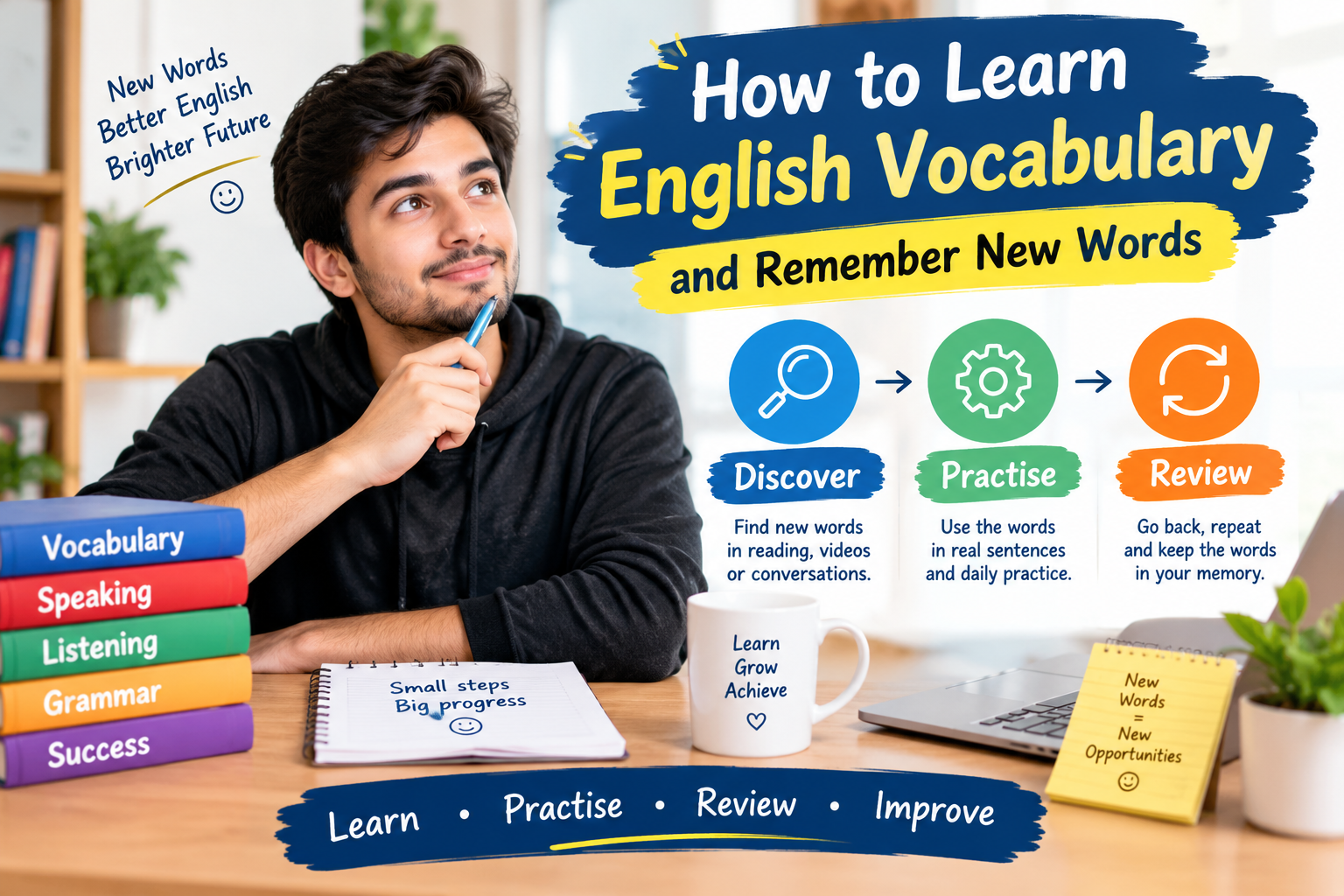
optimistic Brilliant music. Hello there, my friend, welcome! This is Keith from the Keith Speking Academy. So listen, how do you learn Lexicon ? Maybe you just Remember lots of new words, maybe you repeat and recite words, maybe you expose yourself by listening and reading to lots of English.
Discover, practise, and review
All of that is really good, but it’s not enough. And actually, learning vocabulary, there is a very simple way to do it, and that is: discover, practise, and review. That’s all you need. Great! What? Oh, you want more?
It’s more of a circle
Okay, so this “discover, practise, and review” is, it’s actually not a line, it’s more of a circle, right? Discover, practise, and review. Some people think language learning and vocabulary learning is a line that you go along and you get better. In fact, some people think it’s a bit like shopping, you know, in a coursebook you have a unit on food, a unit on sports, a unit on clothes.
A bit like shopping
So some people think, “Well, that’s a bit like shopping,” so they go to the food shop and they buy different items, the vocabulary, put it in the bag. They go to the sport shop, buy some shoes, some clothes, different items in the bag. They go to the clothes shop and buy the items and put them in the bag and think, “Great, I’ve gone to all these shops or units in my book and I’ve got lots of vocabulary. Great!”
The vocabulary is in your bag, not in your head
But the vocabulary is in your bag, not in your head. That is the problem, and it’s because vocabulary is not just a line where you collect all the words. The vocabulary that you learn, this circle of discover, practise, and review for each word or vocabulary, is actually, it means you’ve got lots of these little circles developing as you’re learning, they’re getting bigger, they’re bouncing, they’re changing, sometimes they’re crashing, sometimes they’re overlapping.
Discovering new words
This discover, practise, and review, so listen, let me explain to you these three points and how they can help you learn vocabulary effectively so you don’t forget it. Discover. Okay,Find this is Finding new words. Okay, so maybe you find or Find a new word in a story you’re reading, in a video you’re watching, or a vodcast you’re Attending to, and then you may guess the meaning or go to a dictionary and check, so you’ll see maybe more examples of the word and you Locate its Character
What do I mean by personality?
What do I mean by Character? I mean, first of all, is it a noun, a verb, an Quickly, an qualifier? What does it sound like, the Phonetic? Which friends does it have? So in the example, you’ll see a collocation, at least one colloction, the words that go together with this word. So you’re Locating all of these aspects of the word.
Learn Lexicon in context
What does this mean for you? It means it’s really Critical to learn Lexicon in context so you can get this Data, Particularly phrase, and you know Superior how to use the word. Second it’s important you know how to use a dictionary because Occasionally you can’t guess the meaning and you have to check, and the dictionary can help you get the phonetic script and other examples.
Being a detective
I think learning vocabulary is a bit like being a detective, right? When you come across a new word, you have to think, is it important? Is it worth finding out more? If the word, you know, you can guess the meaning, it’s not very common, you can just let it go. But if you see a word you don’t know but it keeps coming up again and again and you don’t know the word, then it’s time to investigate.
Get your Sherlock Holmes hat on
Get your Sherlock Holmes hat on and investigate the word, right? Find out the meaning, the pronunciation, all the things that I’ve mentioned. As a Lowest, I would say if a word is Essential make sure you know one meaning, there will be many, but just get the main one you need for the moment, the word form (noun, verb, adjective, adverb), the pronunciation, and one Phrase , and that’s enough.
Language learning is a marathon
Over time, do you remember those little circles? They will grow and you’ll learn more about the word over time. Don’t rush it. Language learning is a marathon, right? Not a sprint. Let’s take an example, right, and I’ll show you through the dictionary what we might do.
Shop around
Imagine I’ve been reading a book and this sentence came up: “Jane thought the jumper was too expensive, so she decided to shop around.” Okay, I can guess more or less the meaning and I know the word “shop” as a noun, but here I can see it’s a verb. So I just go into the Cambridge Dictionary to check.
The Cambridge Dictionary
Now, I say the Cambridge Dictionary, you can use Collins, Merriam-Webster, they’re all good, right? The Oxford Learner’s Dictionary is good. “Shop” comes up as a noun, I knew that, but it’s also a verb, right? To buy things in shops, and interesting, the examples: “I like to shop at secondhand shops.” “I’m shopping for food.” Okay, so I’m learning a bit more. I’ll make a note: “shop for.”
A phrasal verb
That’s good to know, but I want “shop around,” so that’s a phrasal verb, right? So I can just actually search for, ’cause most dictionaries have phrasal verbs as an entry, “shop around”: to compare the price and quality of the same or similar object in different shops. So it’s comparing the prices. Great, got it.
Like a criminal record
Okay, I’ve got the pronunciation, which I can paste and copy, I can even listen to it here, it’s great. So now I’m building up all this information like a criminal record on this word, right? That’s it, the discover process. Practice, the second step, practise, and this is where you try to use the words, right?
Practise them to learn them more deeply
I mean, it’s all well and good having all these new words in your book and your bag, but you need to practise them to learn them more deeply. Now, you can practise through writing, through speaking, through just repeating words, or better still, all of the above, all of those, right? Now, there’s a very simple technique that I show in my course, my online course, which is Speaking Success System, which is where you change different parts of a sentence.
Change the noun
So let’s take an example, right. For example: “I am shopping around for a new jumper.” Okay, now I’m gonna ask you to repeat that but to change the noun, okay, to a new noun. I’ll show you a picture and then you change the word, change the noun. “I’m shopping around for a new jumper.” Change “new jumper” to this: “I’m shopping around for a new phone.” Great!
Change the tense
Now change to this: “I’m shopping around for a new car.” Excellent! Now change the tense to the past tense: “I was shopping around for a new car,” or it could be “I shopped around,” “I shopped around for a new car,” right? Change to the future: “I will shop around for a new car,” or “I’m going to shop around for a new car.” Could even say, “I will be shopping around for a new car next week.”
Change the person
Okay, finally, you could change the person. Instead of saying “I like to shop around,” what about “she”? “She likes to shop around.” Okay, so through this kind of changing different words, vocabulary, and different tenses, you’re practising and practising and building your flexibility.
Something that is true for you
And then finally, you could just make up little stories or make up your own sentences which are true for you, right? Something that is true for you. “I actually hate shopping around, but my wife always shops around when we go to buy something.” It’s absolutely true. Saying things that are true for you make the language more personal and deeper, your learning is deeper.
Training, Training, Training
So what Perform this mean for you? Practise, practise, practise, that’s what it means for you. Chuckles. If you’re on your own, you can practise like this, repeating. If you’re, I dunno, with other people or have friends you can practise with, in conversation you can do it, or just writing as well, or all of the above.
Let’s move on: review
Let’s move on: review. Okay, part three is review, and this basically means getting some kind of feedback so you deepen your understanding of the word. There are maybe two main ways to get feedback on your practise of the word and your understanding of the word. One is the classic: a teacher or another student corrects you when you make a mistake, right?
Feedback from a teacher
You say, “Oh, she shop around for new clothes,” and the teacher says, “No, no, no, she shops around.” “Oh, right, got it.” Right, so that’s one way of getting feedback. You can get feedback from a teacher. Actually, you can also get feedback from real life.
Out in the real world
I think this is quite funny, talking about, “The classroom is not real life.” “Real life is out in the world.” “No, but in the classroom I’m still alive.” “Yes, but it’s not real life.” But when you’re out in the real world, okay, the other real world, I know many of you are living in English-speaking countries, and when you’re out practising language, you say something and the reaction of the other person, the native English speaker, makes you think, “Oh, something’s not right,” and you often learn from that experience, right?
You can’t shop around our prices
For example, “shop around.” Maybe you go to a shop, you speak to the shop assistant, and you say something like, “Well, I like this jumper, it’s nice, but I’m going to shop around your prices with other shops,” and the shop assistant goes, “What? What do you mean, shop around our prices? You can’t shop around our prices,” and you think, “Oh, something’s not right,” and you discover, maybe you go and check or you ask, and they tell you that you can’t shop around prices, you shop around for something, but “shop around” already means comparing price, so you can’t say “shop around your prices.”
Expose yourself to English
Okay, so that situation gives you feedback. The other way to get Response is when you Uncover yourself to English and you ‘repaying attention to stuff, watching videos, and reading, and you see the word again and again in different contexts, and each time you see the word in a new context, it reinforces your learning and Intensifies
your understanding of how to use it, Particularly if you’re actively noticing that, right?
Making an effort to notice
Making an effort to notice: “Ooh, shop around, I learned that last week and here it is again,” and just notice how it’s used. Also, the fact that if you can learn vocabulary not only in reading but in listening and watching, the different medium help you deepen your understanding. So that’s it, the review is basically getting the feedback.
Expose yourself to the language
What Perform this mean for you? I think it means that you must, as well as practise, is you must expose yourself to the language as much as possible so that you can see it in different, see the, the word in different contexts and different situations and deepen your learning. If you can get a teacher to give you Response that could be Practical
Teacher correction
Teacher correction is not always the best way because, as teachers know, students often don’t listen to correction, they just carry on. So Rectifying only works if the student is ready, right? But there are other ways to get the Response and Reexamining andUncover yourself to the language is a great way to do it.
So there it is
Great! So there it is: discover, practise, and review. This cycle when you’re learning vocabulary, it’s going on and on, and I think being aware of that and trying to do this is really useful. I guess one of the key messages is that when learning vocabulary to not forget it, try and see or hear vocabulary in as many different ways as possible, different contexts, and try and use it in lots of different ways as well.
The Speaking Success System
This methodology, if you like, is a simplified version of the methodology I use in my online course, IELTS Speaking Success, Get a Band 7 Gold. The methodology is the Speaking Success System, and it’s a way that I use to help students learn vocabulary so they don’t forget it.
Breakout rooms
What they do is that they discover the language through the model answers in the course, they’re then practising chunks, like changing different parts of the sentence, with recorded videos, and I’m giving them prompts and the answer as well. They can practise in breakout rooms, so that’s real-time breakout rooms online with other students in very small groups, and they can review the language with quizzes.
It takes time
We have mini stories to help see the language in different contexts, all of that to help you learn vocabulary so that you don’t forget it. Do remember, it takes time, right? It’s not a line that you accumulate, it’s not shopping, it’s building up all these little circles over time with patience and practise.
Be patient, be curious, notice things
So be patient, be curious, notice things, and remember to be a detective. You have to decide if it’s worth investigating a word and then how best to investigate the word so you can learn about it in a deep way. Nice!
Subscribe and turn on notifications
Listen, if you’ve enjoyed this video, please do subscribe and turn on notifications, and if you like this, then I think you should watch the next video coming up, which will show you how to think in English. Oh, and by the way, if you want a summary of this with some extra examples so you can start practising and developing this habit to help you learn vocabulary and not forget it, download this free PDF.
Take care, my friend
Just click on the link in the description below. You just exchange your email and I will give you the PDF for free. If you give me your email, you can also get more freeClass Supply and other things that will help you on your journey to learn English, Grow your speaking skills, and if you’re studying IELTS, ace the IELTS Speaking Test. Take care, my friend, bye-bye. cheerful, bright music.
Every heading is made only of words that already Seems in its own paragraph, and the paragraph text is unchanged. For the title, your message cut off before the actual title came through. Send it over and I’ll work on it. Keep in mind that a Rephrased title will contain words that aren’t in your original, so if you want to Evade combining numbers, anything, I can build one from General in the article, such as “find, Rehearsal and Review.”